
Regenerative Cooling Optimization #2
February 4, 2026
The previous regenerative cooling optimization reached a critical limitation were even with optimized channel geometry, throat wall temperatures remained around 950 K. The fundamental issue is heat flux density at the throat is too concentrated for convective cooling alone to handle without either:
- Extremely narrow channels (unmachineable), or
- Unacceptably high wall temperatures.
This entry documents the solution: film cooling. The dataset is using pure ethanol as fuel without adding water.
Film cooling works by injecting a thin layer of coolant along the inner wall surface, creating a protective “film” between the hot combustion gases and the metal wall. This coolant absorbs heat directly from the gas boundary layer via convection, and provides a thermal barrier also evaporates that reduces heat flux to the wall.
The injected film coolant reduces the effective gas-side heat transfer coefficient and lowers the driving temperature for wall heating.
Of course, it will also reduce the O/F ratio (if fuel is used for cooling), thereby lowering the combustion temperature and specific impulse.
Regenerative Cooling Only
This is RPA data:
First, we re-ran the analysis with refined geometry but no film cooling to establish a baseline.
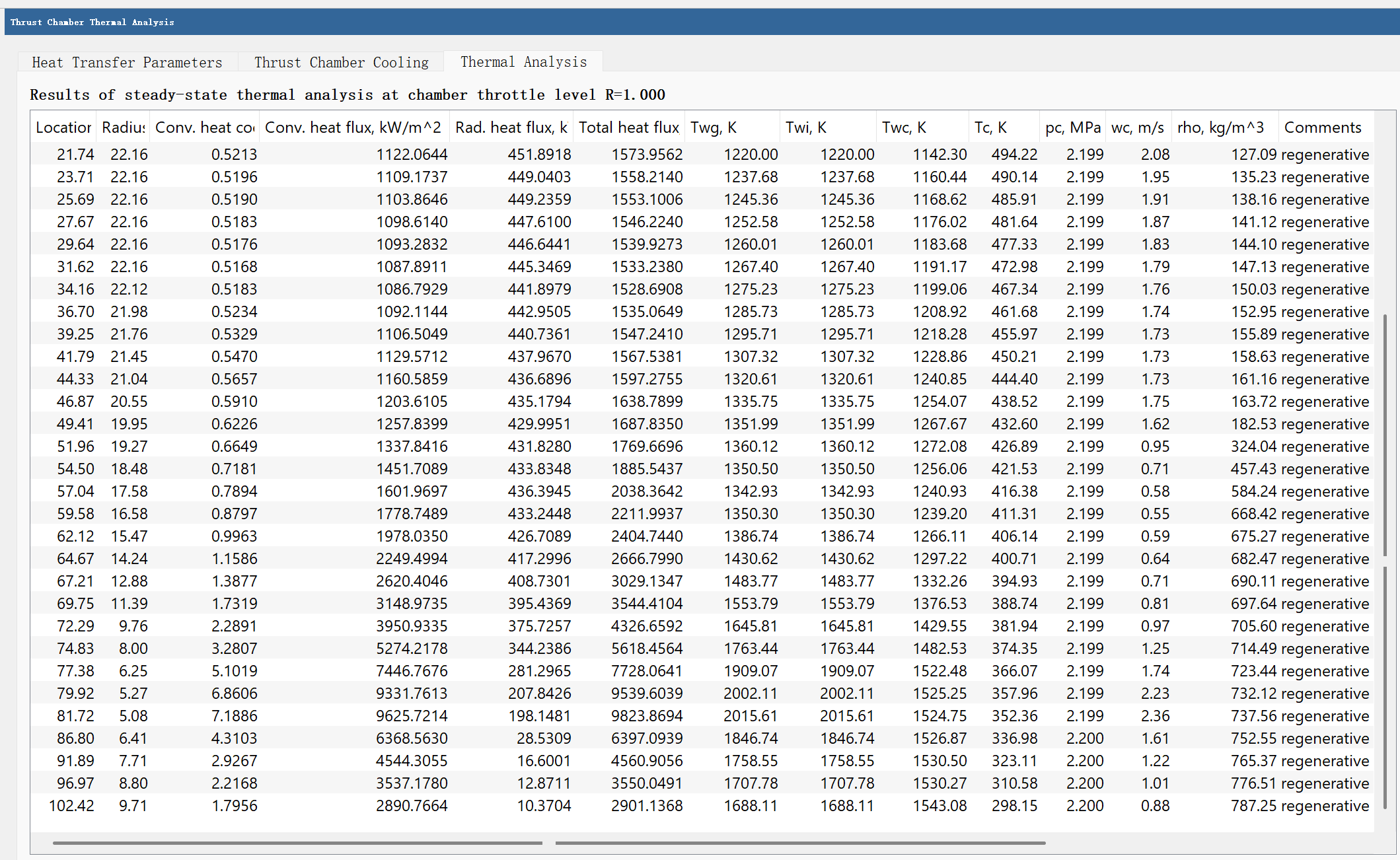
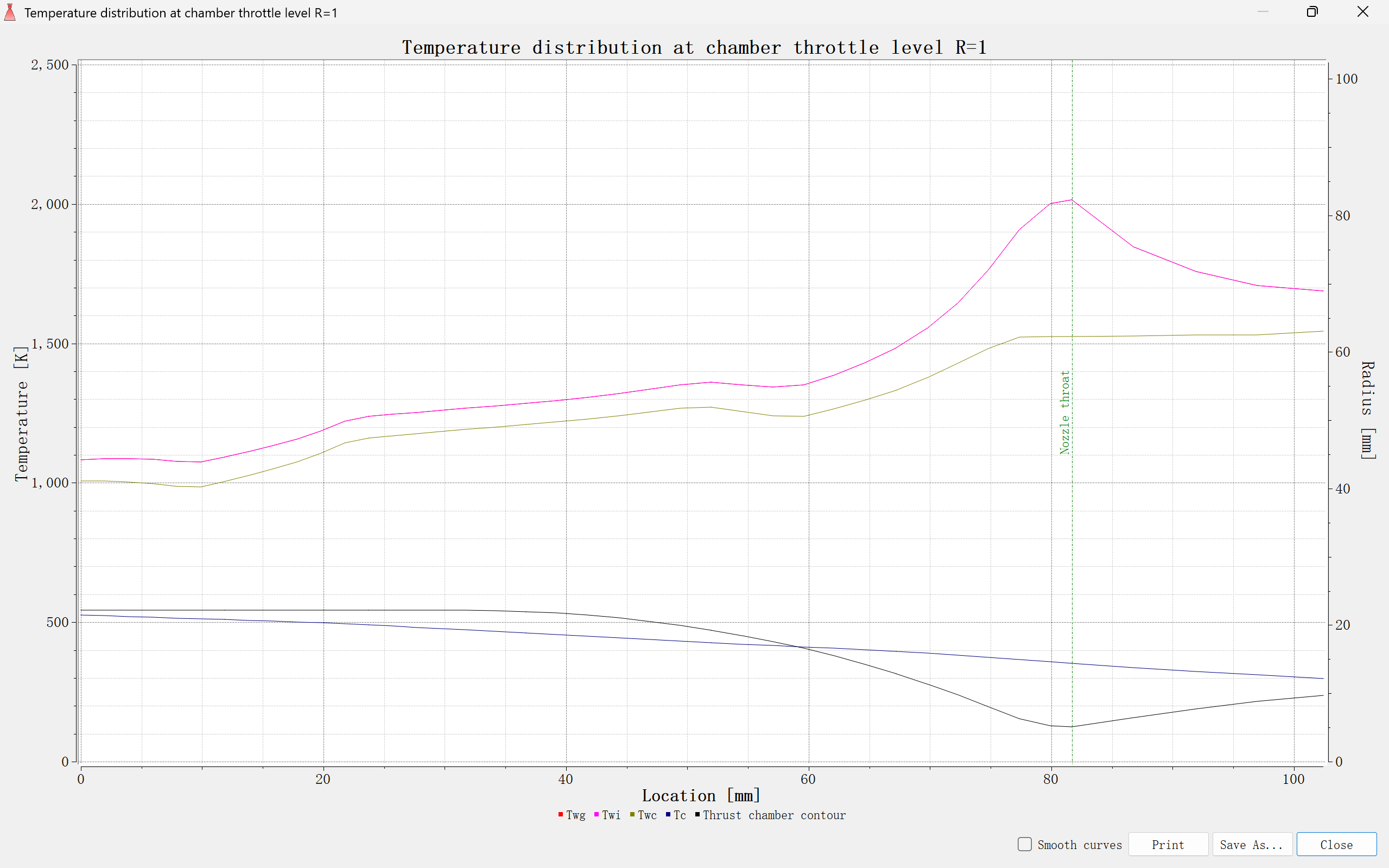
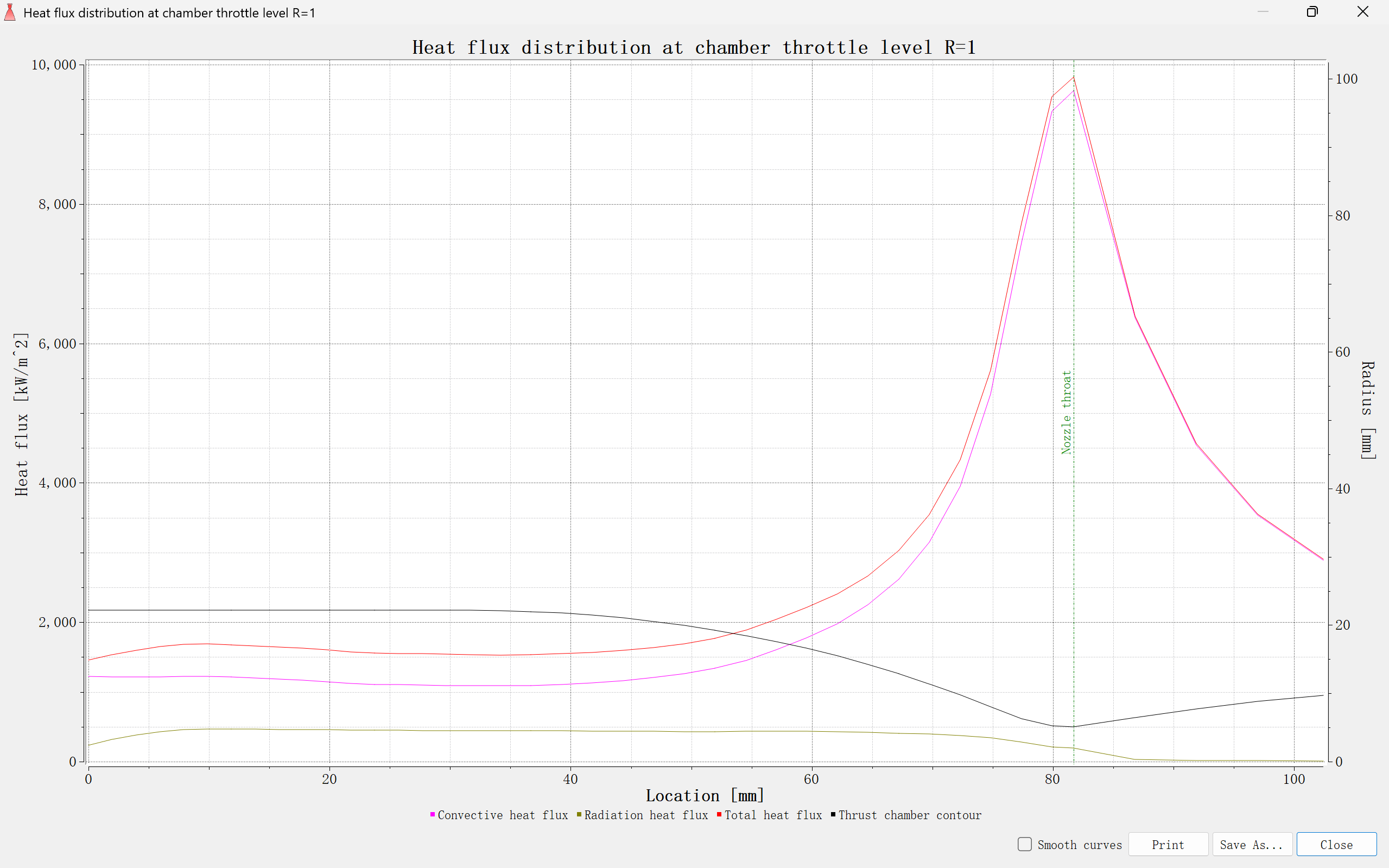
We are able to find that:
- Maximum wall temperature (Twg): 2015 K at the throat (81.7 mm)
- Peak heat flux: 9626 kW/m²
- Coolant-side wall temperature (Twc): 1530 K
At 2015 K:
- Aluminum melts (~930 K).
- Stainless steel loses most of its strength (~1200 K softening).
- Even high-temperature alloys (Inconel, copper alloys) begin to degrade structurally.
As we predicted, the high heat flux of the small engine is the cause of the problem.
With Film Cooling (17% Mass Flow)
We introduced film cooling by injecting 17% of the total coolant mass flow (relative to the regenerative coolant flow) as a thin film along the inner wall, starting upstream of the chamber.
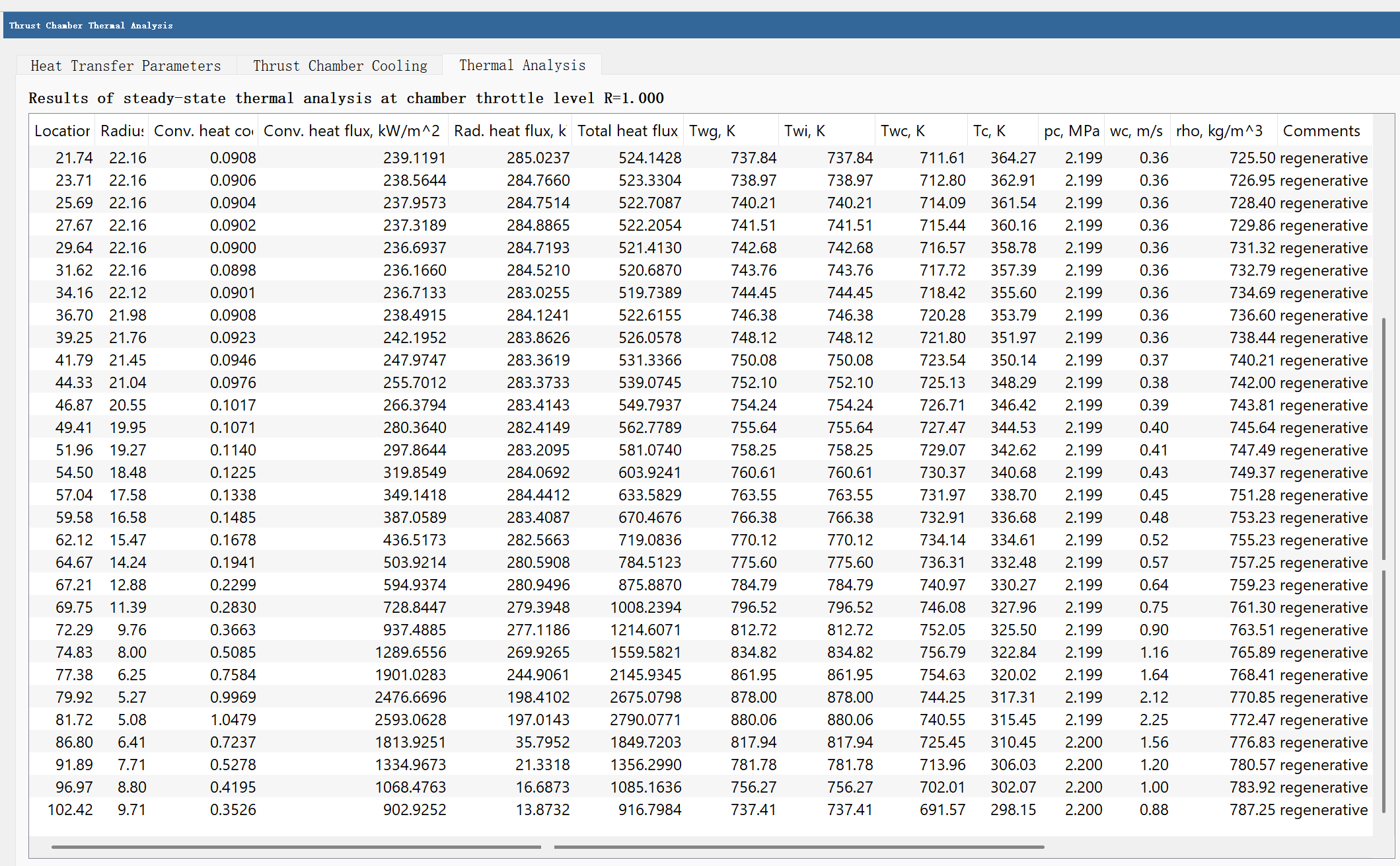
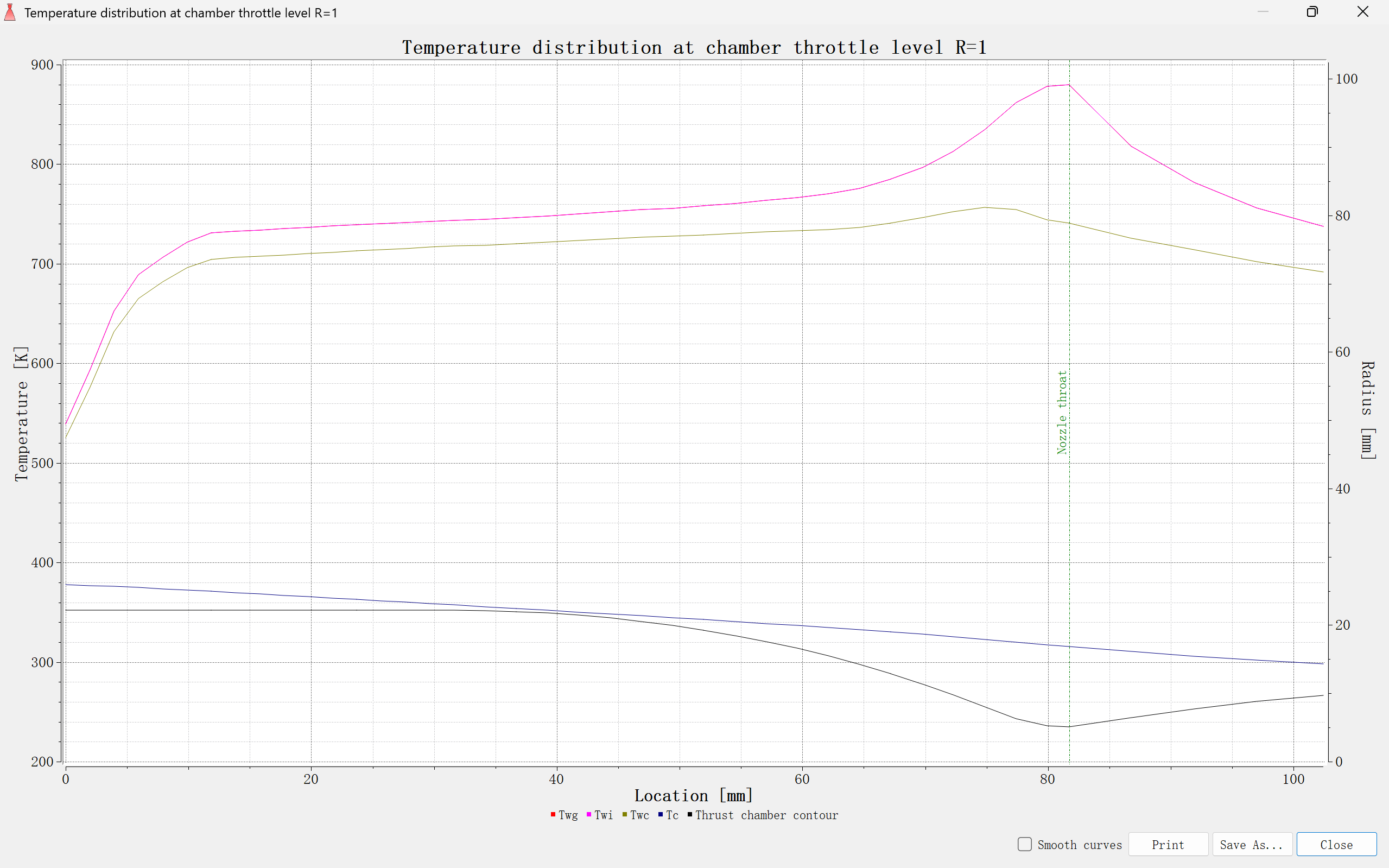
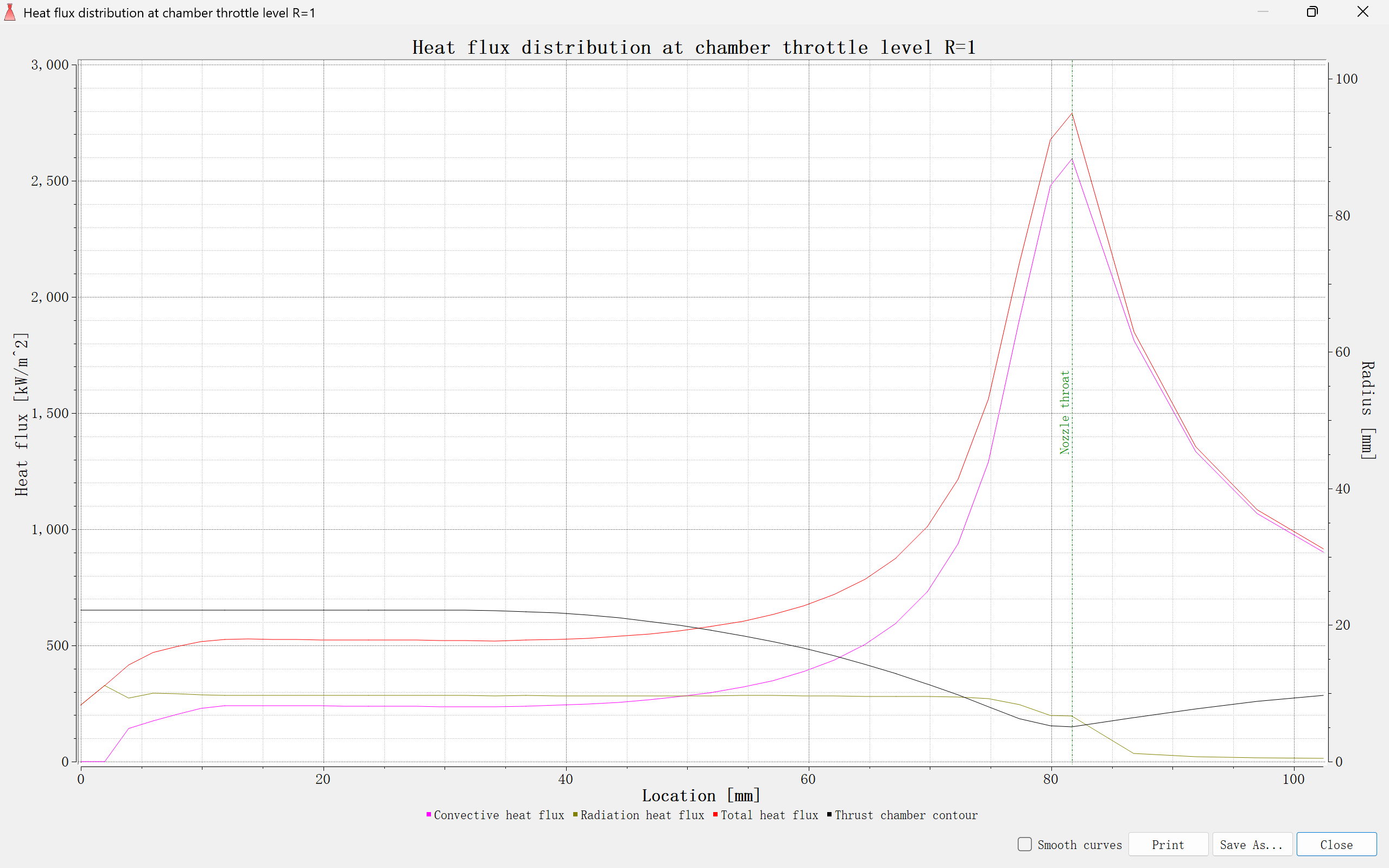
As can be seen from the diagram, the temperature at the top of the engine is lower because a liquid film is injected at the top.
- Maximum wall temperature (Twg): 880 K at the throat (81.7 mm)
- Peak heat flux: 2790 kW/m²
- Coolant-side wall temperature (Twc): 744 K
Performance Comparison
| Parameter | Pure Regenerative | With Film Cooling | Improvement |
|---|---|---|---|
| Max wall temp (Twg) | 2015 K | 880 K | -56% |
| Max heat flux | 9626 kW/m² | 2790 kW/m² | -71% |
| Coolant-side temp (Twc) | 1530 K | 744 K | -51% |
| |
The film cooling layer provides a factor of 2.3× reduction in peak wall temperature which bringing it well within the safe operating range for copper alloys, stainless steel, and even aluminum (with coatings). The ethanol also stopped boiling.
Notice: Since the O/F ratio remains unchanged, and the fuel in the film cooling section is essentially not involved in combustion, the main combustion chamber becomes more fuel-rich, theoretically resulting in a higher specific impulse. Although the overall specific impulse decreases, this loss requires further investigation. It is foreseeable that the decrease in Isp due to fuel loss will be greater than the increase in Isp due to the increase in O/F.
Based on the material, film coolings are not a panacea. The effectiveness depends on injection velocity and angle, which must be low enough to stay attached to the wall (not blow off into the main stream).
In our case, 17% film flow strikes a balance between thermal protection and acceptable $I_{sp}$ penalty (estimated ~2–3% loss due to incomplete mixing).
Next, transient simulation of the nozzle will be performed to ensure it meets design expectations. Another critical part is to validate film injection geometry, direction and method to minimize $I_{sp}$ penalty.