
Combustion Chamber L* Optimization
January 7, 2026
Characteristic Length (L*) Analysis
A critical parameter in combustion chamber design is the characteristic length L*, which directly affects combustion efficiency and chamber geometry. L* represents the ratio of combustion chamber volume to throat area and serves as an empirical indicator of propellant residence time.
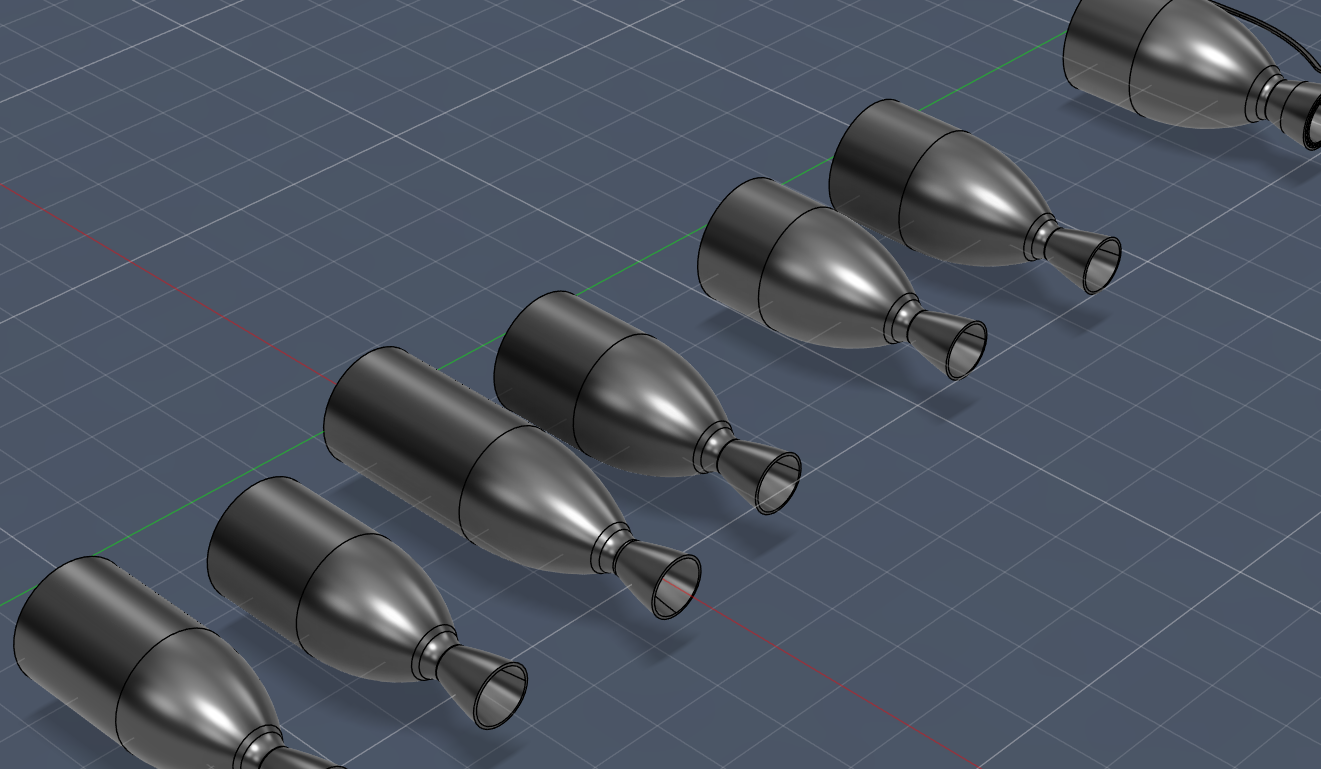
We evaluated L* values ranging from 0.5m to 1.5m to understand their impact on chamber design. Some materials indicate that a sufficiently long L* is needed to achieve complete combustion, while others suggest a much shorter one. Since the chamber length depends on the calculated L*, an excessively long L* could make the engine resemble noodles, while an excessively short L* would allow insufficiently atomized gas to directly reach the convergence zone.
- Lower L values (≈0.5m)*: Result in shorter, more compact chambers but may compromise combustion completeness
- Higher L values (≈1.5m)*: Provide extended residence time at the cost of increased chamber length and mass
Therefore chamber length scales directly with L*: Each increment significantly affects overall engine geometry.
The combustion chamber length is influenced by both L* and the contraction ratio $A_c/A_t$ (chamber area to throat area). From the defining relationship:
$$L^* = \frac{V_c}{A_t}$$
For a cylindrical chamber, $V_c = A_c \cdot L_c$, which gives:
$$L_c = \frac{L^* \cdot A_t}{A_c} = \frac{L^*}{A_c/A_t}$$
This shows that chamber length $L_c$ increases proportionally with L* but inversely with the contraction ratio. These factors determine how to achieve optimal combustion efficiency within geometric constraints, the permissible control range of the TVC control system under fixed size conditions, and (though less important) how to make the engine relatively “like a engine”.
Design Selection
A sufficiently large L* is chosen to ensure complete combustion, but not too large. Exceeding the required length significantly increases mass and manufacturing costs; increased internal surface area leads to increased regenerative cooling pressure and heat loss without improving performance.
However, this doesn’t mean we can directly choose a smaller L*. On the contrary, smaller engines should opt for a normal or higher L* due to limitations in manufacturing precision.
For small engines, choosing an excessively low L* shifts the limiting factor from combustion completeness to manufacturing feasibility. Consider the chamber diameter relationship:
$$D_c = \sqrt{\frac{4 A_c}{\pi}} = \sqrt{\frac{4 \cdot (A_c/A_t) \cdot A_t}{\pi}}$$
For a fixed throat area and contraction ratio, a smaller L* forces a correspondingly smaller chamber diameter to maintain the target chamber volume. This creates several compounding problems for small engines:
Manufacturing Precision Limits: Modern metal 3D printing (SLM/DMLS) achieves feature resolution around 0.1-0.2mm and surface roughness Ra 5-15μm. When chamber diameters drop to 30-40mm or below, regenerative cooling becomes nearly impractical. To keep inner wall temperatures within the long-term stability range of common metals (such as aluminum alloys at ~200-250°C), cooling channels would need to be approximately 0.1mm in cross-section, which is impossible for low-cost manufacturing.
These tiny features are not only difficult to print consistently, but powder in the internal channels can also clog the flow paths. Unsintered powder trapped in sub-millimeter cooling channels can cause flow blockages, although it is unclear whether they can be removed using high-pressure inert gas. In any case, the smaller the channels, the more difficult it is to ensure complete powder removal during post-processing.
A smaller chamber diameter means less internal surface area available for heat transfer. This is critical because small engines already suffer from extremely high heat flux densities (often 5-15 MW/m² at the throat region). The heat flux scales inversely with characteristic dimension:
$$q’’ \propto \frac{1}{D_c^{0.2}}$$
Reducing chamber diameter further concentrates this thermal load, this further increases the requirements for regenerative cooling efficiency, namely thinner wall thickness, higher flow rate, and even greater tank pressure, which complicates everything.
This is why we selected L* slightly above 1.0m. It provides sufficient combustion volume and maintains sufficient surface area for effective thermal management while keeping the combustion chamber size within comfortable manufacturing tolerances.