
Chemical Analysis
November 2, 2025
This update summarizes how we choose mixture ratio, thrust, and chamber pressure for a small GOX/ethanol engine.
Mixture Ratio
The mixture ratio is defined as
$$r = \frac{\dot{m}_o}{\dot{m}_f}$$
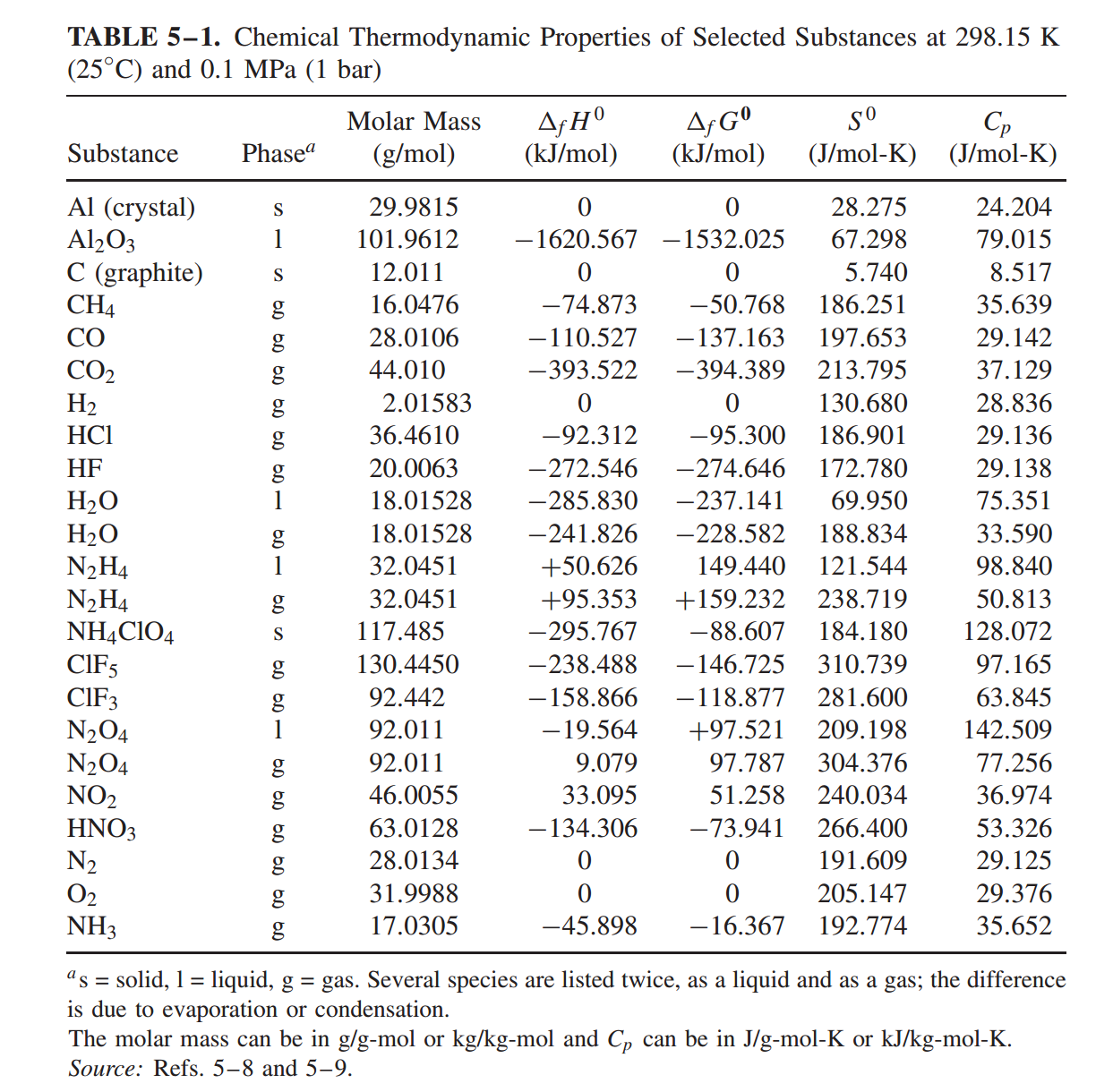
In Rocket Propulsion Elements (8th ed., Ch. 5), the thermodynamic property tables underpin why mixture ratio matters: lower molecular weight products generally raise $I_s$ and $c^*$. This helps explain why the optimal mixture ratio is often fuel-rich rather than stoichiometric. Sutton & Biblarz show this explicitly for LOX/LH2, where the optimal ratio is around 4.5-6.0 rather than the stoichiometric 8.0, because fuel-rich exhaust has lower molecular weight and therefore higher $I_s$.
Today we use NASA CEA software to study combustion mixtures. See https://cearun.grc.nasa.gov/ for the official CEA web interface.
How We Choose Thrust and Chamber Pressure
The thrust equation anchors the sizing loop:
$$F = C_F \cdot p_c \cdot A_t$$
This equation has a recursive aspect, so when we do not yet have a vehicle-level target, we typically start from thrust and chamber pressure… With those two values, CEA lets us compute $A_e/A_t$, $c^*$, and related performance quantities for a chosen mixture ratio, which then gives a consistent throat size.
Where $C_F$ depends on expansion ratio $A_e/A_t$, gas properties, and ambient pressure. Based on the materials, the recommended method is roughly as follows:
- Pick a target thrust range based on test goals and safety limits.
- Choose a reasonable chamber pressure $p_c$ based on hardware and cooling limits.
- Select an expansion ratio for sea-level or near-sea-level testing.
- Use $F = C_F p_c A_t$ to compute throat area $A_t$.
- Check geometry, mass flow, and cooling feasibility, then iterate.
This is the same logic as Sutton’s method, but adapted for a ground-test engine where geometry and cooling drive early constraints. These can now be achieved through CEA.
CEA Results for GOX/Ethanol
We ran NASA CEA for GOX/ethanol to map temperature, $I_s$, and $c^*$ versus O/F for several chamber pressures. Selected plots are included below.
For reference, the idealized overall reaction can be written as:
$$C_2H_5OH + 3O_2 \rightarrow 2CO_2 + 3H_2O$$
Graph 1: Chamber / Throat / Exit Temperature vs O/F
Graph 2: Ivac / Isp / c* vs O/F
Graph 3: CF / Ae/At / Exit Mach vs O/F
From these curves, we are able to find that:
- Within the tested range, the best $I_s$ occurs on the oxidizer-rich side rather than at the lowest O/F.
- Chamber temperature rises quickly as O/F increases.
- Higher chamber pressure improves $I_s$ and $c^*$, but with diminishing returns. The gain from 20 to 30 bar is smaller than from 10 to 20 bar.
- As O/F continues to increase past the optimum, performance gains flatten and then begin to decline.
Therefore, we can deduce that achieving high efficiency in the combustion of ethanol and oxygen mixtures would pose a very stringent challenge to cooling. However, increasing the amount of ethanol (the regenerated coolant must be liquid) would reduce the O/F ratio, leading to a significant decrease in efficiency. Therefore, a balance must be found, and the ideal value is likely between 1.2 and 1.6.
References:
- Sutton, G.P., & Biblarz, O. (2017). Rocket Propulsion Elements (8th ed.). Wiley. (Ch. 5, Figs. 5-1, 5-4; Table 5-5; Ch. 2-3, 6)